
Work In Progress // Ideas may be underdeveloped, prose clunky
Every disruptive new technology leads society to confront and reconsider humanity’s relationship with its machines. The generational emergence of Artificial Intelligence produces worldwide angst amongst knowledge workers they’ll soon be out of a job. A contemplation of our unavoidable path towards coexisting with this breed of machines, too.
01> [Introduces Lee Sedol and the AlphaGo game]
When the best go player in the world took on the strongest computer program, I could not decide who to root for. The year was 2016, and Lee Sedol was probably the most famous person you never heard of. In fact, unless you live in Japan, China or Korea, it is unlikely you ever encountered the game of go. But for me, the refined game with its elegant wooden board and simple black and white stones was a love of 20 years. We didn’t have any strong professional players in the West, but we all knew Lee from the reports and analyses of the tournament scene in the Orient. Compared to ours, their level of play was more than one order of magnitude stronger – with soft spoken Lee the dominant megastar of them all. And yet compared to our level, there had never been a computer program we couldn’t trounce with ease. Go, with its infinite number of variations, was thought to be beyond the reach of computers and require hard to grasp concepts such as human intuition, a sense of poetry even. But that changed when DeepMind, a Google outfit, tested AlphaGo against a European pro. A relative unknown and lowly ranked one, but a professional nonetheless. And in March 2016, AlphaGo challenged the world’s strongest player to a best-of-five match competing for a $1 million prize. This was gripping stuff, but I couldn’t decide who I hoped would win. I am an engineer at heart. Curiosity, problem solving and innovation or not second but first nature to me – and witnessing the birth of what many considered to be the holy grail of Artificial Intelligence would easily be one of the most exciting events of my life. But on the other hand I had a very emotional relationship with the game I’d been playing for twenty years. Being so far beyond human control made it feel divine, and I wasn’t sure I wanted that to change. Lee was confident before the match. Not because he backed the gods, but because he backed himself. That’s the champion’s mindset, and what a formidable champion he was. Almost overnight, Lee Sedol had become a household name, as the whole world went on Youtube to see how the duel would unfold.
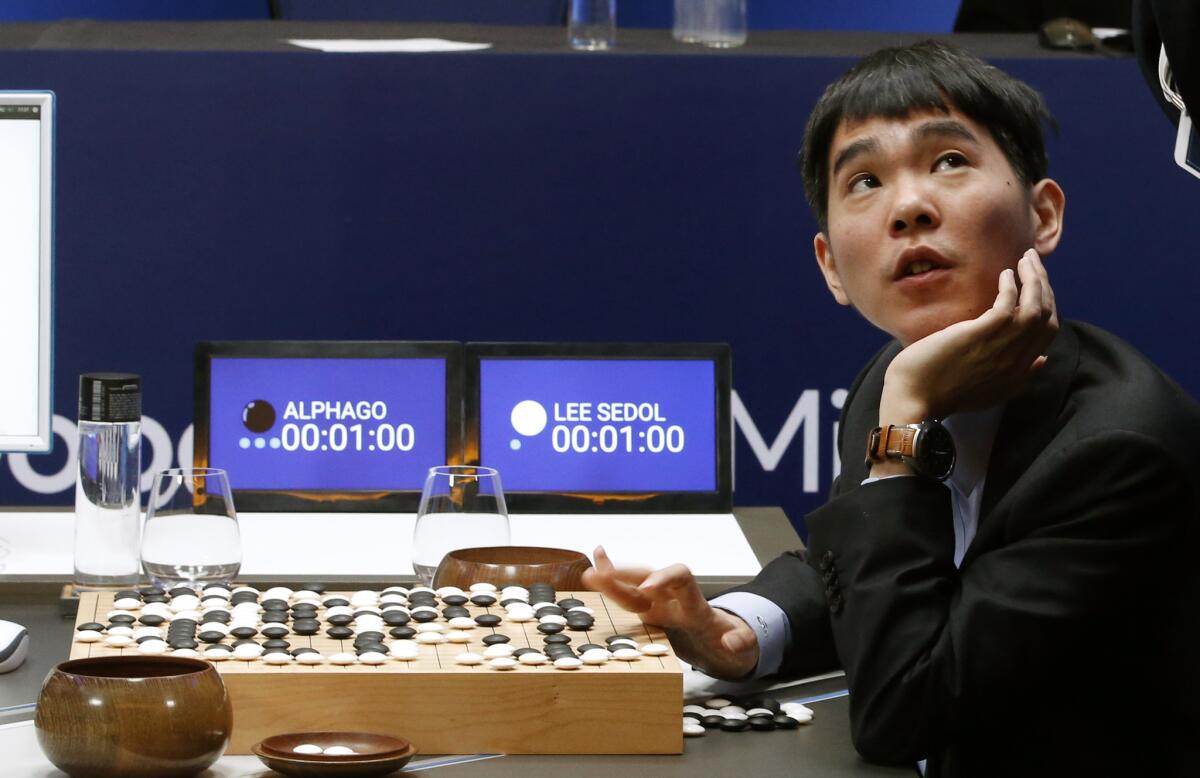
Representing humanity, Korean go superstar Lee Sedol takes on the machines, represented by Google Deepmind’s Alphago.
02> [The professional go scene, how pros train and compete]
Professional go players have trained in the same way for centuries. Strong players become teachers – sensei – gathered a school of students – insei. Insei played practice games with each other and and worked on series of problems, with sensei helping with analysis.
<><><>
Pros trained by playing and analyzing with other and especially stronger players as teachers.
They compete in multi-game title matches, for prize purses up to 100Ks.
03> [Amateur go. How I trained. Why we wanted to have strong computers.]
All of that is a far cry from what’s available to you in the West, when you discover go. My problem wasn’t finding a teacher, but finding someone, anyone, to play a game with. Since I couldn’t find any, I taught the rules to my best friend and starting playing him. (He went on to become a far stronger player than I was, and ended up playing a decade longer too.) Completely cut off from a rich ecosystem to tap into, we spent a considerable amount of time teaching each others interesting new mistakes, of course. At some point we discovered there was a small national association of players, which helped us start a small club in our home town. The impact on our strength was negligible, but it increased our enjoyment level enormously. The association had given us the names of a handful of interested people in the region, and we pestered them until they agreed to dust of their bowls and come play with us. They were a bit better, but we were bright university students. Obviously we relished the opportunity to invest a fantastic amount of time in an intellectual pursuit that had nothing to do with our degree. The prospect of taking down a few greying gentlemen was to us what a school of migrating salmon is to a bear. Not the toughest prey in the world, but succulent none the less. But they kept coming. Like a sleeper cell of veteran spies, they’d been dormant but only the right signal away from activation. They fought back, determined to hold the eager new generation at bay. They should have known better, the poor naive souls.
But how we longed for strong computers. We were still weak players, and none of us had authoritative answers to problems of strategy and technique that vexed us. We bought books and read magazines – problem there was the analyzed pro games were of such a high level they tre&ted problems we weren’t strong enough for yet. The emergence of the internet helped. Online game servers at least allowed you to find an opponents literally any time of the day, of any matching strength to your own. It didn’t really help much with the analytical part. My friend jumped on the opportunity, played a lot and ran away from me in strength. I could have done the same, but complicated my life by that time getting more interested in running the marathon.
<><><>
04> [The two worlds meet: two games against Honda-san.]
Very occasionally, the pro world and our own world met. When our local club existed for a few years, city council reached out to us. A delegation from their Japanese sister city was going to visit, they had a contingent of go players, and would we show them around town a little before we played a friendship game with them? By the way, one of them is a professional player from the highest rank. A lot went wrong in preparation and execution, including our Japanese translator calling in sick the morning of the event, but go players are nothing if not creative and inventive – so at the right time I solemnly delivered my club president welcome speech to our distinguished guests, in the no less distinguished historical halls of the university we had secured for this event. Thank you for your visit and let the games begin. The strongest of us had the unenviable task of facing the professional, who offered to play with a four stone handicap. Soon the frowning, sighing and hand wringing of our friend got matched by some amount of hmmm-hmm’ing and head scratching on the pro side, and when our friend ended the game losing by about 6 or 7 points he felt rather good about his performance. The pro suggested a couple of improvement points, and on other tables an equally good time was had by all.
As afternoon gave way to evening, we trotted our Japanese friends to the beautiful medieval part of town, where we had made reservations for a nice dinner. We now lost our backup translator, but alcohol lubricated whatever linguistic friction remained. And once we’d converted starter and main into a pile of dirty plates and crumpled napkins, out came the go boards again to converse in the one language we all understood. Our Japanese friend, it had to be said, extracted maximum merriment out of a minimum of alcohol, but our own side got in the spirit of things too and our strongest player boldly challenged the pro to a revenge match. He agreed, this time with a five stone handicap, and in no time at all proceeded to dismember our friend by 50 or 60 points. It’s hard to remember the decorum of teaching games when you’re jet lagged and tipsy.
<><><>
05> [The match. Move 37. Move 78.]
<><><>
Why it’s a big deal – allusion to chess. In the Artificial Intelligence world, Go had always been the holy grail. Solving chess was a feat, but chess is to go as toddlers are to rocket scientists. When Deep Blue beat Kasparov in 1997, it was viewed as a major accomplishment in computer science but it didn’t feel like an existential threat to humanity. For go, things were different. Computationally speaking, the game itself is infinitely more complex and, according to the greatest players, requires certain intuitive and aesthetic qualities believed to be beyond the realm of machines for decades. But then DeepMind came along, and they trained a system by having it play itself for a couple of months. They didn’t even program the rules, they left all of that for the machine to figure out by itself, and when it was done training they didn’t even know how it worked internally.
Game 1. Lee reaction?
Game 3 – Move 37 was the decisive blow that won AlphaGo the series, The machines were 3-0 ahead, and while most professionals initially doubted AlphaGo could win even one game, its performance was so dominant and decisive it now looked doubtful Lee would be able to avoid a 5-0 whitewash.
Game 4 – with resolve and strength of character, under what must have been pretty traumatic circumstances, Lee managed to win the fourth game. If move 37 in game 3 baffled humanity, Lee’s move 78 in game 4 stumped the machines. (And the professional commentators alike – it was every bit as astonishing and divinely inspired.) AlphaGo went on to win the series 4-1, and Lee Sedol became either humanity’s last man standing, or the world’s first knowledge worker to lose his job to AI.
No fairytale ending. Was Lee the first knowledge worker in a very high end field to lose his job? If he can’t win, how can any of us?
06> [AI today: knowledge workers fearing for their job. The history of new technology impacting work.]
Explosion of tasks that AI is taking over.
Long history of new technology. Not new, Jevons paradox, why would this time be different?
Something IS different and at first sight it is bad news: this technology has the ability not only to automate tasks, but to restructure entire workflows, companies and competitive ecosystems. Choudary describes this reasonably well in Reshuffle.
Go in some more detail. Allusion to Pace Layers? It’s likely the “rules” ie Governance layer will also change. Society will not tolerate a few happy people take everything: it will reorganize. If politicians don’t do it via regulation, society at large will do it via revolution.
Paint the picture of what is likely to happen: analogy with the internet, eventually permeating absolutely everything – but humans are astonishingly good at adapting too. As long as there are human problems to solve, there will be jobs. Subtext the importance of the human element.
<><><>
Fast forward ten years, and today’s headline is all knowledge workers’ jobs may be on the chop. That’s certainly what the bosses of the leading AI companies are telling you. Maybe it is their honest belief, or maybe they try to justify ever loftier valuations for their scale-ups. And at first sight, this is already happening, with several high profile companies pointing to the productivity benefits of AI as justification for their most recent round of corporate restructuring. But even if that is not entirely true, that’s what shareholders would want you to say which makes it good PR – and if that instills a bit of anxiety and intensified professional zeal in your own work force, so much the better.
How realistic is the prospect of a meaningful number of knowledge workers getting replace by AIs? Is massive white collar unemployment imminent? Impressive as it looks, is the performance of current and soon-to-be-released Artificial Intelligence systems really good enough to do the job of a wide range of knowledge workers? And even if it is, will that result in mass lay-offs? What can historical cases of emerging technological innovation teach us, and what could be different this time? And looking beyond the technology itself, how do we need to consider it in the context of the broader business and societal systems?
All of these are pressing questions, and they are as close to home as my own team which is openly wondering if they should fear for their role. So let’s take a dispassionate look at where we are, what is likely to happen next, and what would generally need to be true for knowledge work to go extinct.
07> [A better way of looking at the likely impact: systems view vs task-view.]
New technology is as old as the hills. And initially, it was warmly welcomed by humanity. Early on in his masterpiece Energy and Civilization, Vaclav Smil describes the economic impact of innovative agricultural technology: the introduction of plough culture with animal traction over hand hoeing. Hoe culture yielded an energy return of 2-3x for every calorie invested, while plough culture returned 4-8x the energy invested. This elevated mankind from a hard life, constantly teetering on the edge of starvation, to a society producing an energy surplus. Actually the central thesis of Smil’s book is that this view of productivity – an energy surplus – is what enables the upward arc of civilization in the first place.
Subsequent marvels of technological innovation and engineering weren’t always as enthusiastically received. Especially during the Industrial Revolution of the 17th and 18th century, when the progress of human civilization quickly gathered steam, workers feared their wages would be reduced because of the machines – if their jobs weren’t eliminated altogether. The textile industry is the most famous example of them all. The same environment that introduced the flying shuttle and spinning jenny also gave birth to the act of sabotage.
And yet, as Gutenberg displaced monks, Excel displaced slide rulers, and car mechanics stableboys, humanity as a whole didn’t exactly run out of work. That isn’t to say that people and their jobs weren’t affected at an individual level. All of mankind prospering is cold comfort when your job and skills just expired. But the historical record indicates that no, AI will not be different and is just the latest in a long series. This too shall be digested.
08> [Back to the pro scene: illustrates how what happened is exactly what we described in the abstract.]
If all of that is true, we should already see it in the go scene. And we do.
Tournament play has changed. Games are much closer, approaching perfect play. but much more uniform as well. Everybody plays the same AI-like style. The good old days of Takemiya Masaki’s “cosmic play”, Kato “The Killer” Masao etc are over. [link this back to first person narrative: we loved those nicknames and go commentary was written using that sort of narrative and allegory.] Looking out for cheaters is now a thing too, and there’s been a few scandals and bans in China. [Subtext to chess with Hans Whatshisname.]
Commentary and analysis have changed too. Commenting and analyzing the biggest tournament games used to be about a bunch of high level players – and their insei – get together and debate. They had the benefit of multiple brains, and endless time after the game to play out variations or try alternatives. This time it’s different. At any moment, close to instantaneous, a machine will spit out an adjusted probability win for Black and White, and its suggestions for the best move – which itself is asymptotically approaching perfect play.
When I was still heavily involved in amateur play, the Japanese Go association commissioned a very well produced manga – and then anime – with the intent of popularizing Go. The hero of Hikaro No Go was a young student-turned-insei – Hikaru – with a secret: he was possessed by the spirit of ancient Go master Sai. Hikaru initially just channeled the moves suggested by Sai – causing a sensation and raising eyebrows in the go community – but eventually broke free to develop his own moves and style. Sai, for his part, was still restless after 1,000+ years because of some vague love story I can’t remember and, more importantly, his quest for the perfect move, the “Hand of God”. Perhaps he was searching for Move 78, and perhaps he briefly took possession of Lee Sedol. In any event I hope his go-soul found peace.
Training has changed. No longer insei / sensei culture, but computer play. [Need to include pop culture reference to Hikaru No Go.]
But humans still play tournaments, and prize money hasn’t dropped.
<><><>
09> [Back to Lee and me. Where is he now? How is my relationship with the machines?]
Lee retired in 2019. He develops games now.
The computers are there, but I can’t say I take full advantage. It will have to be for the time I pick it up again. And I envision games in my garden, very clumsy, at modest level, against equally fallible human opponents. We’ll laugh at each other’s and our own stupid moves, and drink a glass of wine.
Move 78.
Move 78
Credits
Words
> Stefan Verstraeten
Ideas
> Vaclav Smil – “Energy and Civilization: a history”.
>
Photo
> Header – Move 78 in replay of Game 4, Lee Sedol-AlphaGo, by Stefan Verstraeten
> Lee Sedol by the LA Times
Video
> AlphaGo https://www.youtube.com/watch?v=WXuK6gekU1Y&t=2s
Ideas
0> “Reshuffle” (Choudary) talks about impact on 3 levels: task [Work], architecture [Infrastructure] and the competitive ecosystem [Context?]
0> See also Pace Layers, and what does it all tell you for knowledge workers? What opportunities await for managers and company leaders to rearchitect work processes?
0> Current trend in software engineering: some rave about vibe coding, but it turns out the work is low quality and not very functional (=hype). On the other hand some very experienced practitioners like Miessler, Bowman… manage to leverage the new tools as if it’s a purely agent-based replacement of an entire software engineering org. So the hypothesis is that it doesn’t do much for low skilled script kiddies, but can make the already sophisticated orders of magnitude more productive.
0>From first principles: the only two ways this will have an impact is task automation (efficiency) or something that hits the Goldrattian Constraint (architecture). With far more impact from the latter. So this seems consistent with Choudary.
0> Another lens: Alicia Juarrero’s constraints. “What can AI do” is an agentic way of thinking. “What constraints would AI dissolve” is Juarrero thinking.
0>
0>
0>

