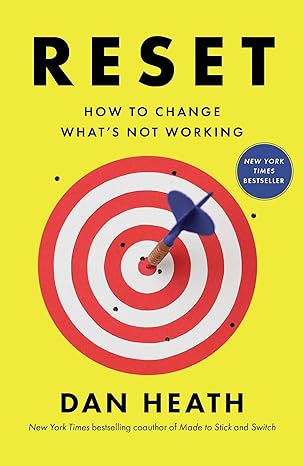
Dan Heath’s “Reset” starts like it’s the easiest and most comprehensive way to bring flow-of-work thinking to a broad audience. Ultimately, it is more a practical manual than an explanatory first principles book. It’s entertaining on a first read, and useful to come back to many times. Don’t store it away too far, but use it with caution.
I expected this book to be an instruction of first principles, but I should have known better. Dan Heath and his brother Chip write books which are practical. Twenty years ago I was reading “Made to Stick”, and decided to use its tips when writing an employee award nomination for one of my people. He promptly won. (That amused him greatly. He was in the know on my plan but because he was a bit of a maverick, he didn’t typically get much love from senior managers.)
Readers familiar with agile, lean and the Toyota Production System, and Eli Goldratt’s Theory of Constraints will recognize a lot in the first five chapters, grouped under the Section heading “Find leverage points”. But Heath doesn’t tell, he shows – using a series of compelling real world examples. Chapter 1, “Go and see the work”, uses a hospital’s mail room case as an example of Toyota’s “going to the gemba” concept. Chapter 4, “Target the constraint”, is of course Goldratt, but illustrated with an author trip to the drive-through of his local Chick-Fill-A.
The examples work. They are interesting to read, and capture the essence of the chapter’s concept well. A summary at the end of each chapter sets the reader up to apply the principle in their own work environment. There’s also a reference to a page on danheath.com with recommended reading or other relevant resources. Readers who want to get a lot of practical use out of the book will not be disappointed: if they invest the time and effort, Heath gives them everything they need to be successful.
“
As to methods, there may be a million and then some, but principles are few. The person who grasps principles can successfully select their own methods. The person who tries methods, ignoring principles, is sure to have trouble.
”
― Engineer Harrington Emerson, on knowing your principles, in “The Clothier and Furnisher” (July 1911)
While the first five chapters deal with analysis, the next six deal with actions to effectuate actual change. Per the book’s introduction, the title’s Reset aims at unsticking a certain situation where a manager or teams feels stuck. The unifying heading for this section is “Restack resources”, and this is where the book gets a little trickier.
I don’t have any quibbles with the recommendation as such, which are sensible enough (and again illustrated with compelling real life examples). I question though if the intervening managers will be effective without some more understanding of the underlying concepts and principles. If nothing else, how will they make the right judgment call on which method to apply and which resources to restack?
The six recommended techniques again borrow heavily from fields like lean (“Recycle waste”) and agile (“Start with a burst”, “Accelerate learning”). And for a while I was undecided if I liked the book or not. But on balance, I am positive. Ideally a reader will also dive deeper into the first principles and mental models behind the methods, but a lot of that literature and public debate has been taken over by overzealous protectors of the One True Way. In Agile, for example, many of the principles have been so institutionalized in frameworks that the emphasis of many practitioners and teams has shifted to the bureaucratic and ritualistic. And in Lean, I know certified Six Sigma black belts doing dumb things as they don’t think for themselves any more.
“Reset” steers clear of this, bringing the topics back to so simple ideas and reasons why they work. That will require the action-oriented reader to do further thinking and studying for themselves, but all things considered I think that is a good thing. Furthermore Dan Heath packed this considerable practical wisdom in an easy and entertaining book. For that reason, it is now my recommendation to friends interested to start learning more on this area, instead of the more rigorous but drier texts I personally usually prefer.
Dan Heath // “Reset”
Credits
Words > Stefan Verstraeten
Ideas > Dan Heath, “Reset: How to change what’s not working“, January 2025 (Avid Reader Press / Simon & Schuster), ISBN13 978-1668062098
Photo > Book cover
Video > “Set and Reset”, Trisha Brown Dance Company (1983)