
Work In Progress // Ideas may be underdeveloped, prose clunky.
Essay architecture
01> Thesis [2]: If we only capture what’s real, we don’t capture everything? We miss out the most important part. Too many people think too functional.
01a> Catalyst [2.3] Put more in your work than mere functionality. Design teams and roles that create space for meaning
02> Title [3] Loosely attributed to Joan Miró. I heard ‘Surreal, More Real… Than Reality Itself’ in the Berlioz song, which itself links back to the interview by Charlie Rose.
03> Spirit [7] – Connect 1st person (Naoshima, people manager experiences) with 2nd person (people managers and product designers) with 3rd person (Ando, Gaudí as designers of spaces)
04> Microcosm [2.1] Minamidera. Encapsulate the whole essay in the first section: the design object -> people injecting meaning in it
05> Motif [9.3] Naoshima
06> Conflict [6.1] As designers we need to create spaces but not define meaning on somebody else’s behalf; the architects were great product designers but were they good leaders;
07> Threads [7.2] – As people managers one of our products is meaning to our people; Architects (and artists in general) don’t force anything on their audience but invite people to create meaning
08>
09>
10>
11> Structure [5] – Sequence [5.1]
11.1 – Minamidera in Naoshima, to encapsulate the entire piece and introduce the thesis of “we all design spaces other people bring their meaning into”
11.2 – Miro’s inner world, to introduce the topic of the non-functional
11.3 – Architects: Gaudi and churches
11.4 – Ando, to go from outside-focus to inside-focus symbolized by concrete and light
11.5 – Ando and Gaudi as bosses
11.6 – We as designers: the non-functional gives design its soul
11.7 – “Naoshima is inconvenient”
Connecting threads [6.2]
11.1 connects to 11.7 – We start and end in Naoshima, 11.1 1st person experience and 11.7 with 2nd person conclusion (“we”) hung on an Ando statement about Naoshima
11.2 connects to 11.6 – Miro’s 3rd person exploration of the non-functional, linked to 11.6 2nd person call to action for us to incorporate non-functional aspects in the spaces we design
11.3 connects to 11.5 – Architects as builders connecting to architects as bosses
11.4 – Ando’s concrete and light symbolizing the heart of the entire essay, and transition from understanding how it works on the outside to designing it from the inside
Research questions
01> Deepen the reference to “Naoshima is inconvenient”
02> How did Gaudi treat his workers?
03> How does Ando treat his workers?
04> How do I treat my workers?
Blurb
11.1> Minamidera and Naoshima
When my family and I were waiting in front of Minamidera, we expected nothing.
Minamidera is a small, simple wooden structure where there used to be a Buddhist temple, on the island of Naoshima. It was the summer of 2023, and we were about half way our big family vacation touring Japan. By that time we had experience getting around, but it had taken us a while to get there. After packing and checking out in the early morning, we made our way to Okayama Station to take the JR Setoohashi Line to Chayamachi Station, where we just made a narrow connection to the JR Uno Line. Once at Uno port, we sorted out how to get on the ferry to Naoshima. And once on Naoshima, we figured out a short term luggage storage solution before we located the information office, who told us if we didn’t dally we were just in time to have a reserved slot to experience the Midamidera art installation to kick off our Naoshima experience. Cooling our heels there, waiting about 10 minutes in front of some solemn, silent guides, was so much the first time that day we stopped going from A to B that we didn’t have the faintest idea of what experience, exactly, we were queueing for. [Chop this in short sentences to create rest, after the long sentence reflecting the long journey.]
When the hour of our reservation arrived, the guides told us very little – but what little they said, the did with great emphasis. They explain the entire visit to the art installation will take about fifteen minutes. They impress upon you to strictly follow the instructions of your guide. Then they lead you through an entrance at the top end of the structure, which immediately runs into a wall. One after the other you follow the guide, who leads you to the right and around a U-bend into darkness. As instructed you hold your right hand to the wall, as you shuffle along around another U-bend where the darkness deepens to complete black, so absolute you fear you’ll bump into the air itself. With your right hand a little lower you feel for an invisible bench against the back wall, advancing as far as you can until the voice of the invisible guide instructs you to sit down until further notice. And then you sit there, in complete silence and completer darkness. Nothing stirs. Nothing happens. You do see, of course, the little darting light flecks you know not to be real but just nerves firing inside your eye. Time passes, your breathing naturally slows down, you wonder when something will finally start happening and your thoughts dart around in your head. After what could be five minutes, but could also be fifteen, you imagine you see a very dim rectangle, in the distance – it could be five meters, but it could also be twenty. Then you tell yourself it’s just imagination, but then you imagine it a little harder. No, it’s definitely a barely perceptible rectangle. How slowly did that light come on. Now you’re certain it’s real, and you think you can even see the opposite side wall a little. You see the guide step forward to the middle of the room, announcing that you are now free to roam the room. The first thing you do is walk over to the other side of the room and find out what the rectangle of light really is.
The Minamidera experience is called The Backside of the Moon, an art installation by James Turrell. As we stepped outside again, eyes squinting and blinking against the blinding light, we didn’t talk much about the experience as we needed to be on our way to the next stations on our art tour. But chewing our sushi that evening, it was Minamidera that made our table talk. My wife and I are engineers, and our sons engineering students. Imagine the part of the conversation where we talked shop on how the thing works. Does the installation gradually illuminate, painstakingly slow and ever so faint even after fifteen minutes? Or did nothing happen, and our eyes simply adjusted to a minuscule amount of ambient light, in darkness that can never have been absolute no matter what we initially believed? If opinions were divided on this operational question, more so on what it all meant. My youngest, characteristically, was the most radical. He didn’t see any point. Underwhelmed. Nothingburger. The rest of us had a more nuanced view. Perhaps it doesn’t stack up there with riding the Hollywood Dream backwards at Universal Osaka, but surely you can’t deny there was an experience there!? Not sure I have an explanation of what it means, but can we agree that what happened is not nothing? Eventually the supply of arguments outran the supply of food, and we trotted back to our onsen rooms, with sleep to catch before another batch of trains or planes.
If anything was inside Minamidera, it was us who had brought it in, Turrell didn’t put it there.
ALT: We all walked out of Minamidera with something different. So it can’t be something Turrell put it there. It must have been us who brought it in.
<><><>
> Predominantly 1st person
> Minamidera as the microcosm containing all about to be explored ideas
> Prejects the non-functional from the outside
> Conceal: it’s an Ando building
> Conceal: parenting, Louis didn’t and doesn’t think there’s anything there, subjectivity of experience and meaning
> Conceal: Naoshima is inconvenient
> Motif “Me in a space”: Minamidera setting, symbolizing even complete absence of functionality can still enable the non-functionality to work as a conduit for projected meaning
01> Minamidera – 1st + 3rd James Turrell + Naoshima
When my family and I were waiting in front of Minamidera, we expected nothing. Minamidera is a small, simple wooden structure where there used to be a Buddhist temple, on the island of Naoshima. It was the summer of 2023, and we were about half way our big family vacation touring Japan. By that time we had experience getting around, but it had taken us a while to get there. After packing and checking out, we made our way to Okayama Station to take the JR Setoohashi Line to Chayamachi Station, where we made a narrow connection to the JR Uno Line. Once at Uno port, we sorted out how to get on the ferry to Naoshima. And once on Naoshima, we hustled some short term luggage storage before we figured out the information office, who told us if we didn’t dally we were just in time to have a reserved slot to experience the Midamidera art installation to kick off our Naoshima experience. Cooling our heels there, waiting about 10 minutes in front of some solemn, silent guides, was so much the first time that day we stopped going from A to B that we didn’t have the faintest idea of what experience, exactly, we were queueing for.
When the hour of your reservation arrives, the guides tell you very little – but what they say, the do so with great emphasis. They explain the entire visit to the art installation will take about fifteen minutes. They impress upon you to strictly follow the instructions of your guide. Then they lead you through an entrance at the top end of the structure, which immediately runs into a wall. One after the other you follow the guide, who leads you to the right and around a U-bend into darkness. As instructed you hold your right hand to the wall, as you shuffle along around another U-bend where the darkness deepens to complete black. With your right hand a little lower you feel for an invisible bench against the back wall, advancing as far as you can until the voice of the invisible guide instructs you to sit down until further notice. And then you sit there, in complete silence and completer darkness. Nothing stirs. Nothing happens. You do see, of course, the little darting light flecks you know not to be real but just nerves firing inside your eye. Time passes, your breathing naturally slows down, you wonder when something will finally start happening and your thoughts dart around in your head. After what could be five minutes, but could also be fifteen, you imagine you see a very dim rectangle, in the distance – it could be five meters, but it could also be twenty. Then you tell yourself it’s just imagination, but then you imagine it a little harder. No, it’s definitely a barely perceptible rectangle. How slowly did that light come on. Now you’re certain it’s real, and you think you can even see the opposite side wall a little. You see the guide step forward to the middle of the room, announcing that you are now free to roam the room. The first thing you do is walk over to the other side of the room and find out what the rectangle of light really is.
The Minamidera experience is called The Backside of the Moon, an art installation by James Turrell. As our family stepped outside again, eyes rapidly blinking in the more than blinding light outside, talk obviously turned to what the “point” of the experience was. Reality hasn’t changed, we had, concluded my young adult sons. I could tell they were trying to decide whether that was cool or lame. It was interesting they gravitated to what he’d done, not yet speculating about how he had done it. I wasn’t so sure Turrell’s point was to make a point, but in essence they were not wrong. Whatever was inside Minamidera, it was us who had brought it in. Turrell, he had put nothing in.
11.2> Miro and the non-functional
]Bridge from 11.1 and frame 11.2: Minamidera resonated strongly with me, because I believe most people only see the functional.]
I thought Backside to the Moon was fantastic, it completely resonated with me. Let me explain. One of my pet peeves in my professional context is people overemphasize the functional and pay almost no attention to the non-functional. It drives me crazy. When they shop for themselves, they can endlessly swoon over the design of their phone or buy cars based on emotional appeal not ratio. But when they need to put a value proposition at work, they get no further than “let’s position such that customer makes a saving”. Product managers thinking more features equals more value. Engineers thinking harder problems equals more value. It’s like saying a person is no more than the sum total of the atoms in their body, or conflating a concert as the same experience as listening to the music in your living room. Or reading it off the sheet, I suppose.
Only considering what’s real is a pretty poor model for the entire experience of reality, and no person was more passionate and vocal about this than Joan Miro. He made it his life’s work to express all the other aspects of existence, exploring the subconscious as every bit as real as the physical world. Especially human beings are so much more than just frisky dirt. Dreams, impressions, sensations, experiences… how could we possibly consider a person complete unless we also consider these things? What could be less real than a person without all of these things?
Miro expanded in the internal universe, and perhaps that is partly because the reality surrounding him was getting smaller and more constraining. For a man of freedom and expression, the Spanish Civil War, oppression of his native Catalunya, and ultimately the dictatorship of Franco, the real world was an increasingly diminished and pointless experience. Miro was working side by side with Picasso, in Paris, when the latter made Guernica. Miro wasn’t an ardent political activist, but he too encapsulated and expressed some protest and criticism in his work. Although I suppose cruelty, injustice, murder and oppression are no less real than joy, bonding and inspiration.
When I heard the phrase “Surreal… more real, than reality itself” in the jazz song “Miro” by Berlioz, I initially thought it was a Miro quote, but it isn’t. It’s how Carolyn Lanchner expressed it, in a 1993 Charlie Rose interview on the occasion of the giant Miro retrospective of the Museum of Modern Art in New York she curated. I saw the interview in the week before I was visiting friends in New York, coincidentally the same week I watch The Thomas Crown Affair in which Pierce Brosnan steals a painting from the Metropolitan Museum and Rene Russo tries to catch him. A museum visit was definitely part of the plan. I hoped my recent viewings would help me take a bit of extra character into these art temples – but which one to pick? I eventually decided on the Met. In the MoMa, the Miro exposition was long gone, and, you know – Rene Russo. Inspiration-wise it didn’t go as I’d hoped. Turns out the Met hadn’t given the film crew permission to work in the museum itself, and the Thomas Crown finale was recorded in the entrance hall of the New York Public Library. Which I only found out after I’d visited the NYPL, unwittingly walking through said entrance hall without recognizing it from the movie. At the library I’d hoped to get inspired soaking in the Rose reading room, but that too didn’t turn out as planned went as it is only accessible to serious scholars, they have no need for romantic tourists. Perhaps I should have spent a bit less time beforehand stitching cute references together in my head, and simply keep my eyes open on the premises. Although I’ve had the opposite experience too: reading about some this or that at a certain place after I visited, and then desperately longing to go back right after my return.
I have mixed feelings about museums. There’s some that make me depressed, and others I’d like to move into. And that has nothing to do with what’s on display, I’m talking the construction itself. Guggenheim bored me and Whitney charmed me. But I know it’s not them, it’s me.
<><><>
> 3rd person exploration of non-functionality, but largely “Miro the man”
> Motif “Me in a space”: the New York museums, symbolizing the real world can resist meaning projection, there needs to be a certain alignment in space and time
>
02> Non-functional – 2nd person + wherever we go
No artist has ever been more vocal about reality’s shortcomings than Joan Miro. If you only consider what’s real, you miss so much of all of reality. He spent his whole career exploring the subconscious as part of existence, every bit as real as the physical world. Especially human beings are so much more than just frisky dirt. Dreams, impressions, sensations, experiences… how could we possibly consider a person complete unless we also consider these things? What could be less real than a person without all of these things?
Miro expanded in the internal universe, and perhaps that is partly because the reality surrounding him was getting smaller and more constraining. For a man of freedom and expression, the Spanish Civil War, oppression of his native Catalunya, and ultimately the dictatorship of Franco, the real world was an increasingly diminished and pointless experience. Miro was working side by side with Picasso, in Paris, when the latter made Guernica. Miro wasn’t an ardent political activist, but he too encapsulated and expressed some protest and criticism in his work. Although I suppose cruelty, injustice, murder and oppression are no less real than joy, bonding and inspiration.
It wasn’t Miro who coined “Surreal… more real, than reality itself”. That’s how Carolyn Lanchner expressed it, in a 1993 Charlie Rose interview on the occasion of the giant Miro retrospective of the Museum of Modern Art in New York. I saw the interview in the week before I was visiting friends in New York, coincidentally the same week I watch The Thomas Crown Affair in which Pierce Brosnan steals a painting from the Metropolitan Museum and Rene Russo tries to catch him. A museum visit was definitely part of the plan. I hoped my recent viewings would help me take a bit of extra character into these art temples – but which one to pick? I eventually decided on the Met. In the MoMa, the Miro exposition was long gone, and, you know – Rene Russo. Inspiration-wise it didn’t go as I’d hoped. Turns out the Met hadn’t given the film crew permission to work in the museum itself, and the Thomas Crown finale was recorded in the entrance hall of the New York Public Library. Which I only found out after I’d visited the NYPL, unwittingly walking through said entrance hall without recognizing it from the movie. At the library I’d hoped to get inspired soaking in the Rose reading room, but that too didn’t turn out as planned went as it is only accessible to serious scholars, they have no need for romantic tourists. Perhaps I should have spent a bit less time beforehand stitching cute references together in my head, and simply keep my eyes open on the premises. Although I’ve had the opposite experience too: reading about some this or that at a certain place after I visited, and then desperately longing to go back right after my return.
I have mixed feelings about museums. There’s some that make me depressed, and others I’d like to move into. And that has nothing to do with what’s on display, I’m talking the construction itself. Guggenheim bored me and Whitney charmed me. But I know it’s not them, it’s me.
<><><>
If you only address the functional, you’re missing out on a lot – sometimes the best part. The part that brings it to live, that gives it a soul. But you don’t get to impose it, at best you create the circumstances for others to co-create it with you.
Pity I visited the wrong museum in New York. But maybe that’s the story – Met and Guggenheim? Met as it was portrayed in The Thomas Crown Affair – which is actually the far more charming entry of the NY Public Library. The Rose Reading Room was off limits: serious scholars only!
[To immediately give the plot away: going to make the case that as product designers and team managers, we have the opportunity to create spaces for others to project meaning in. ] No. Subtext it, but start elsewhere with the functional / non-functional divide.
03> Quest – 1st + TBD space
A friend of mine thinks in terms of Tools and Spaces. Tools are self contained artefacts you can take into your workplace. Spaces are immersive artefacts you go to do get a job done. A hammer is a tool. Your kitchen is a space. Both tools and spaces influence our behavior, as they change our context.
Tools are best when you want to bring software to an existing work context. Spaces are best when you need to create a persistent specialized context. (Think operating theater for surgery.) [is there a link here to an Atul Ghawande story about battlefield surgery?] Many software applications are spaces by necessity, not choice.. Users prefer software that integrates in their existing workflows. In this case you design for components that integrate in those systems.
Affordances are the relationship between users and their tools/spaces. Tools have different affordances in different contexts. Design becomes about discoverability of affordances.
Meaning is an affordance of the work environment we create for people. We very much create work spaces for our people – physical ones, like the office, but more importantly mental ones such as the team and their role. In addition to all the functional bits, people will bring their person into this space, and get inspired one way or another by this context. How could it not?
<><><>
Personal quest to understand the non-functional part.
Need different example than “Alchemy” or “positioning”
Consider going straight to Miro
”
We live entirely, especially if we are writers, by the imposition of a narrative line upon disparate images, by the ‘ideas’ with which we have learned to freeze the shifting phantasmagoria which is our actual experience.
”
― Joan Didion
11.3> Architects – Gaudi
Or is it? Should inspiration, and room to inject meaning, be a deliverable of every designer and architect? And isn’t the ability to go beyond the mere functional, and harness the intangibles, the sign of true craftsmanship and part of the magic separating the towering giants from the low risers?
Miro’s interest was in tapping into his own dreams, subconscious and spiritual reserves as a gateway to a broader experience of reality. But even a man for whom the inner life was his entire theme, even he needed to get in the mood by getting the creative impulse from elsewhere. He professionalized it into a process! He discussed it in Yvon Taillandier’s “I work like a Gardener“.
“On the other hand, the thing I consciously seek is tension of spirit. I find the atmosphere conducive to this tension in poetry, music, architecture (Gaudi, for example, is terrific), in my daily walks, and in certain noises.”
It is hardly surprising Miro got inspired by the work of fellow Catalan Gaudi. For architects, the very nature of their craft is to design spaces that invite people to come in – physically and mentally. I’ve visited the Sagrada Familia twice, and experienced it very differently both times. The first time must have been around 1998. Much construction, a lot of it hidden from sight both in and outside. This was basically an Engineering vision, and we got absorbed mostly by descriptions of the techniques Gaudi used like the upside down chains to model out what the upstanding beams should be shaped like. The second visit was October when what year (2019?), when there were helicopters and big demonstrations all over town. We had lunch while watching live television news of protests happening less than 1 kilometer away outside. A lot more work had been completed on the facades, the towers, and the interior. Also changed in a post-9/11 world: draconian security measures. This wasn’t an Engineering but a spiritual visit, Gaudi clearly hammering home his invitation to experience his evocation of nature as an expression of the divine work of the Creator. Churches are perhaps the least subtle category of trying to control and manipulate where people go, how they line up, how they are corralled off from a priesthood, and above all what they should think – and behave even when they go back outside.
<><><>
>3rd person, but mostly Gaudi through the Sagrada Familia
> Motif “Me in a space”, Sagrada Familia and churches as spaces of forced meaning making
>
The architecture field is most naturally attuned to combining function with non-functional. Although even that is a spectrum with purely form follows funtion’ers on the one hand, and form invokes emotion people like Zaha Hadid on the other.
Churches are not subtle in their intent to manipulate your mind. You could argue they are ham handed in that they host an institution that wishes to impose and prescribe meaning to you. But even then some do it much better than others.
Gaudi seeks to inspire you, make you feel the greatness of God through nature.
How did Gaudi work with other people, how was he as a boss?
05> Architects – 3rd Gaudi + Sagrada Familia
Or is it? Should inspiration, and room to inject meaning, be a deliverable of every designer and architect? And isn’t the ability to go beyond the mere functional, and harness the intangibles, the sign of true craftsmanship and part of the magic separating the towering giants from the low risers?
Miro’s interest was in tapping into his own dreams, subconscious and spiritual reserves as a gateway to a broader experience of reality. But even a man for whom the inner life was his entire theme, even he needed to get in the mood by getting the creative impulse from elsewhere. He professionalized it into a process! He discussed it in Yvon Taillandier’s “I work like a Gardener“.
“On the other hand, the thing I consciously seek is tension of spirit. I find the atmosphere conducive to this tension in poetry, music, architecture (Gaudi, for example, is terrific), in my daily walks, and in certain noises.”
It is hardly surprising Miro got inspired by the work of fellow Catalan Gaudi. For architects, the very nature of their craft is to design spaces that invite people to come in – physically and mentally. I’ve visited the Sagrada Familia twice, and experienced it very differently both times. The first time must have been around 1998. Much construction, a lot of it hidden from sight both in and outside. This was basically an Engineering vision, and we got absorbed mostly by descriptions of the techniques Gaudi used like the upside down chains to model out what the upstanding beams should be shaped like. The second visit was October when what year (2019?), when there were helicopters and big demonstrations all over town. We had lunch while watching live television news of protests happening less than 1 kilometer away outside. A lot more work had been completed on the facades, the towers, and the interior. Also changed in a post-9/11 world: draconian security measures. This wasn’t an Engineering but a spiritual visit, Gaudi clearly hammering home his invitation to experience his evocation of nature as an expression of the divine work of the Creator. Churches are perhaps the least subtle category of trying to control and manipulate where people go, how they line up, how they are corralled off from a priesthood, and above all what they should think – and behave even when they go back outside.
<><><>
The architecture field is most naturally attuned to combining function with non-functional. Although even that is a spectrum with purely form follows funtion’ers on the one hand, and form invokes emotion people like Zaha Hadid on the other.
Churches are not subtle in their intent to manipulate your mind. You could argue they are ham handed in that they host an institution that wishes to impose and prescribe meaning to you. But even then some do it much better than others.
Gaudi seeks to inspire you, make you feel the greatness of God through nature.
How did Gaudi work with other people, how was he as a boss?
”
He became the paragon of coffee-table minimalism. But only the most dedicated had seen his buildings in the concrete flesh. His work was mostly experienced through photographs.
”
― theartnewspaper.com, June 2023
11.4> Architect Ando – integrating concrete and light, presence and absence
11.4.1 – I have visited many churches but not many move me.
11.4.2 –
I like Gaudi. Everybody does. And when I’m standing in the majestic belly of the Sagrada Familia, I am in awe. Everybody is. But the razzmatazz spectacle is not really my style. I prefer unassuming seduction over bombastic hard selling. There’s a church that moves me more: Tadao Ando’s Church of the Light. Like Gaudi, Ando is also in the business of using nature as a conduit to connect the human to the divine. But where Gaudi throws your eye skywards, casting nature as the grandiose expression of a God who encompasses everything, Ando invites you look inwards and discover the divine in stillness and nothingness. Gaudi adds something to your life, Ando suggests what you can subtract. His church doesn’t even have a holy cross, it has two slits in a flat concrete wall.
Churches are tricky, since they are all controlled by The Church. And The Church has masterfully designed two very inspiring places of its own. One channels everything we aspire to – or they would want us to aspire to. But in spite (or because of) its obviously sugar coated sales pitch, I wouldn’t want to be found dead there. The other is supposed to fill me with dread. And I suppose it does.
I should be more specific describing my experience with Church Of The Light. I haven’t visited it, yet. I’ve only seen it on photographs in books, after I saw its description in the Ando House in Naoshima. The Ando House itself is very Ando-esque. It uses concrete, absence of concrete, light, and absence of light.
>2nd person US: you, me and Ando. Use the interviews in such a way that Ando is having a conversation with us. Make sure the it has concrete and light, subtext and imply
>Motif “Me in a space”: books as designed spaces, knowing Church of the Light from books and the Ando museum on Naoshima
> Reveal: Ando is the designer of Minamidera
> Conceal: he is actually the designer of all of Naoshima,
06> Inward journey – 1st + 2nd + 3rd Ando – Space COTL and COTW
I like Gaudi. Everybody does. And when I’m standing in the majestic belly of the Sagrada Familia, I am in awe. Everybody is. But the razzmatazz spectacle is not really my style. I prefer unassuming seduction over bombastic hard selling. There’s a church that moves me more: Tadao Ando’s Church of the Light. Like Gaudi, Ando is also in the business of using nature as a conduit to connect the human to the divine. But where Gaudi throws your eye skywards, casting nature as the grandiose expression of a God who encompasses everything, Ando invites you look inwards and discover the divine in stillness and nothingness. Gaudi adds something to your life, Ando suggests what you can subtract. His church doesn’t even have a holy cross, it has two slits in a flat concrete wall.
Churches are tricky, since they are all controlled by The Church. And The Church has masterfully designed two very inspiring places of its own. One channels everything we aspire to – or they would want us to aspire to. But in spite (or because of) its obviously sugar coated sales pitch, I wouldn’t want to be found dead there. The other is supposed to fill me with dread. And I suppose it does.
I should be more specific describing my experience with Church Of The Light. I haven’t visited it, yet. I’ve only seen it on photographs in books, after I saw its description in the Ando House in Naoshima. The Ando House itself is very Ando-esque. It uses concrete, absence of concrete, light, and absence of light.
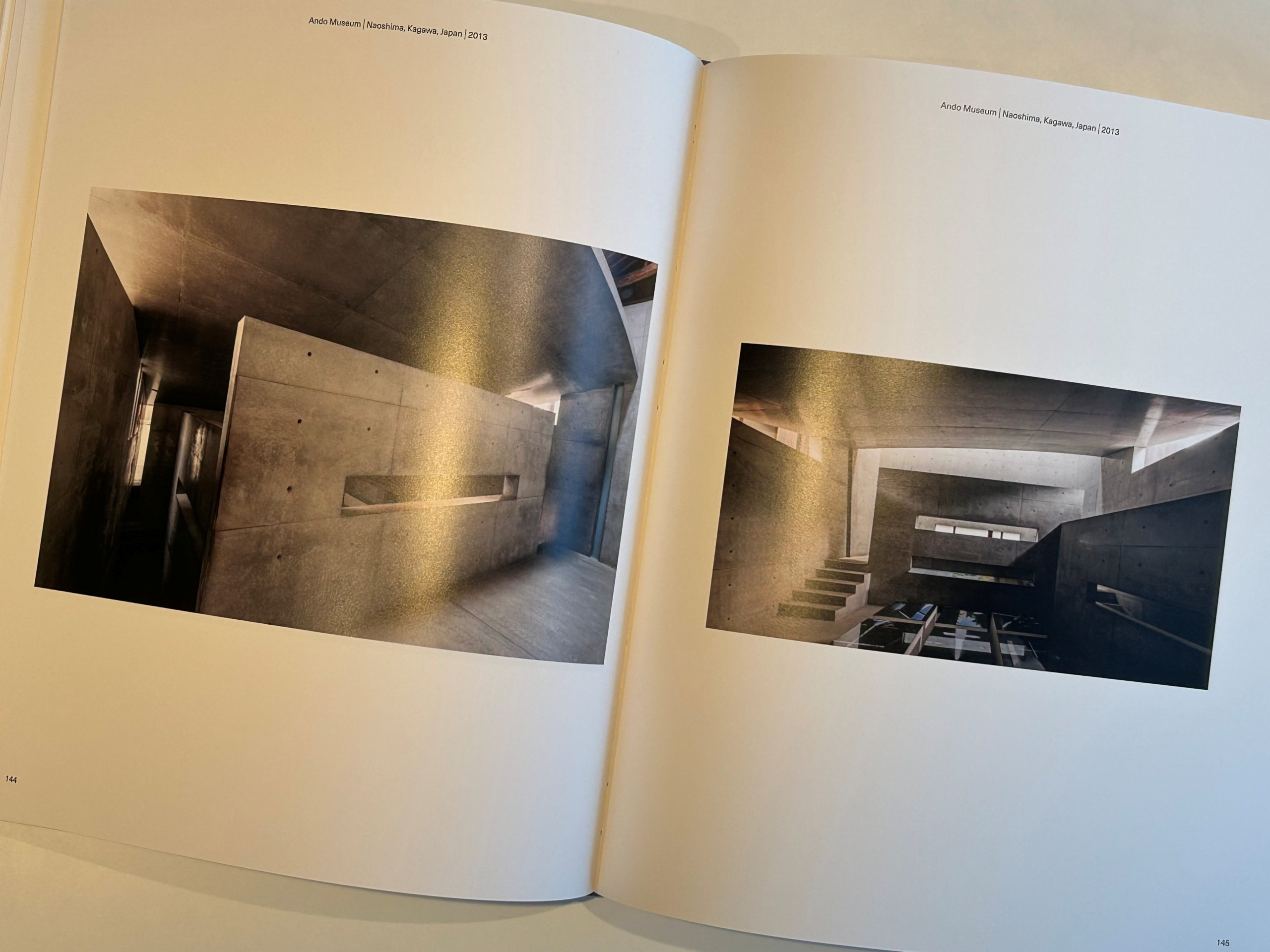
Concrete, absence of concrete, light, and absence of light.
11.5> Ando and Gaudi as bosses
I always get a bit skeptical when I read these things. Big ideas about architecture, should make people quiver with joy and all that. But a wise man once told me to be suspicious of stated preferences, and judge by revealed preferences. Aka “talk is cheap”. The inquiring mind wonders how Tadao Ando was as a boss… Will, it would appear that the man walks the talk. His studio is designed to foster collaboration and bringing out everybody’s contribution. [Ref] etc etc
What kind of boss was Gaudi, burdened by 100 years less of managerial wisdom and best human resources practices? Pretty much the same. At a time when steel magnates and robber barons mercilessly exploited the working poor, it looks like Gaudi ran scrums capturing all opinions from his diverse work force.
When a project is under way, he takes photos of everyone, site manager to plumber.
Tadao Ando Interview: 20 Minutes with a Master | Features | Archinect
>
> Motif “Me in a space”: Me in my workplace. Same building, some team Glints are shit while others are raving. Our group of people as a space.
>
06> Ando as a boss – 3rd and 1st person
I always get a bit skeptical when I read these things. Big ideas about architecture, should make people quiver with joy and all that. But a wise man once told me to be suspicious of stated preferences, and judge by revealed preferences. Aka “talk is cheap”. The inquiring mind wonders how Tadao Ando was as a boss… Will, it would appear that the man walks the talk. His studio is designed to foster collaboration and bringing out everybody’s contribution. [Ref] etc etc
What kind of boss was Gaudi, burdened by 100 years less of managerial wisdom and best human resources practices? Pretty much the same. At a time when steel magnates and robber barons mercilessly exploited the working poor, it looks like Gaudi ran scrums capturing all opinions from his diverse work force.
When a project is under way, he takes photos of everyone, site manager to plumber.
Tadao Ando Interview: 20 Minutes with a Master | Features | Archinect
11.6> Practical design: taking it too far, no friction and nothing but friction. Steve Jobs as a boss? Jony Ive as a designer? Virtual world vs real world.
Architects perhaps not so much, but designers are obsessed with affordances and signifiers, nudges and helpers to assist users in discovering affordances. There’s different schools of thought on the right balance between functionality and form.
Somewhere at the back of a cupboard I have a Philippe Starck juice press. You might have seen it, it won numerous design prizes. It was a wedding gift, and for the longest time the person who gave it to me asked me whether I had used it already. Clearly the thing is for looking at only. It is unusable, try squeezing an orange with it. And yet she kept pressing me for an answer.
That doesn’t mean the friction-free school has all the wisdom either. “Naoshima is inconvenient”, Ando said in an interview. It needs to be. It’s part of the experience. Our society is too low friction. We are used to convenience and instant gratification. But what is frictionless becomes meaningless. You don’t want your ironman to be easy. It’s supposed to be hard, that’s the whole point!
I try to design people’s experiences like Ando. Rather than loading them up with all sorts of stuff, I try to take away. And I certainly don’t eliminate all friction, but try to keep an eye on whether it’s the right kind of friction. [Don’t really want to write this, should be subtext, but then I need much more description woven in of daily work with the team.]
“Music is the space between the notes”, said Claude Debussy. In great literature, nuanced meaning is encoded in what is not expressly stated but whispered in nuance language. The essence of Gyruyère cheese is encapsulated in its holes. OK, that last one was silly but I can’t subtext it any clearer from the rooftops.
>
> Motif “Me in a space”: me in cyberspace
>
07> The juice press – 1st + 3rd Starck + space TBD
Architects perhaps not so much, but designers are obsessed with affordances and signifiers, nudges and helpers to assist users in discovering affordances. There’s different schools of thought on the right balance between functionality and form.
Somewhere at the back of a cupboard I have a Philippe Starck juice press. You might have seen it, it won numerous design prizes. It was a wedding gift, and for the longest time the person who gave it to me asked me whether I had used it already. Clearly the thing is for looking at only. It is unusable, try squeezing an orange with it. And yet she kept pressing me for an answer.
That doesn’t mean the friction-free school has all the wisdom either. “Naoshima is inconvenient”, Ando said in an interview. It needs to be. It’s part of the experience. Our society is too low friction. We are used to convenience and instant gratification. But what is frictionless becomes meaningless. You don’t want your ironman to be easy. It’s supposed to be hard, that’s the whole point!
I try to design people’s experiences like Ando. Rather than loading them up with all sorts of stuff, I try to take away. And I certainly don’t eliminate all friction, but try to keep an eye on whether it’s the right kind of friction. [Don’t really want to write this, should be subtext, but then I need much more description woven in of daily work with the team.]
“Music is the space between the notes”, said Claude Debussy. In great literature, nuanced meaning is encoded in what is not expressly stated but whispered in nuance language. The essence of Gyruyère cheese is encapsulated in its holes. OK, that last one was silly but I can’t subtext it any clearer from the rooftops.
11.7> Back to Naoshima
Use the “Naoshima is inconvenient” concept as the vehicle to wrap it all up? Would be a nice way to end where we began.
>
> Motif “Me in a space”: writing?
08> Back to Naoshima / Tie it all up?
Use the “Naoshima is inconvenient” concept as the vehicle to wrap it all up? Would be a nice way to end where we began.
Surreal, More Real… Than Reality Itself.
Credits
Words
> Stefan Verstraeten
Ideas
> Catheryn Lanchner
>
Photos
> Church of the Light
Video
> Interview with Carolyn Lanchner
> berlioz – “Miro”
Ideas
0> Miro, Gaudi and Ando are all meaning makers. Their work nudges people and invites them to connect with something bigger than reality.
0> All three were or are lifelong workers. Miro worked until age 90 and passed away shortly after the completion of “Woman and Bird”. Gaudi died age 73, when he was hit by a tram while on his way to work at Sagrada Familia. Currently 83, Tadao Ando is still active.
0> How were they as bosses though?
0> Ando commented in an interview on leaving the glass out the cross at Church of the Light. “The wind coming in is very important.” https://www.alainelkanninterviews.com/tadao-ando/
0> In the same interview, Ando comments how Naoshima “is inconvenient”, and how that is important, how for example the convenience of smartphones reduces experience.
0> Another one, text from Ando SPECIAL INTERVIEW “TADAO ANDO” | ENGLISH CONTENTS | あなたの旅を彩るウェブメディア|comforts.jp
0> This is a characteristic of good architecture. You can study it on paper, but it needs to be experienced. The very purpose of architecture is to shape and guide people’s experiences. Spaces and forms speak to our deeper psychological and spiritual dimensions, two domains transcending what’s real.
0> Perception shapes reality.
0> Ando and Gaudi both use architecture as spiritual technology. Both view nature as a gateway to the human soul. But where Ando wants to reconnect you with nature as an inherent part of your self, Gaudi uses it as a pathway to the divine. For Ando, humans are a work of nature. For Gaudi, nature is a work of god.
0> Ken Wilber’s point that human beings are more than “frisky dirt”
0> “When my family and I were waiting at the small wooden Midamidera pavillion, we expected nothing.”
0> Architects are creators of spaces that invite people to make meaning. So too are good business leaders and people managers.
0x> Gaudi [v] and Ando – both connect to nature, but from different vantage points
0x> Tadao Ando, Church of The Light, Church on the Water
0x> Ando: “Naoshima is inconvenient”
0> On 02 Miro from “I work like a gardener” article Maria Popova, reference. “(I’m reminded of Susan Sontag: “Our task is not to find the maximum amount of content in a work of art… Our task is to cut back content so that we can see the thing at all.”)”
0> Books and movies as another space we bring our meaning into. But they leave far less space for interpretation, freedom.
0> Kristof Van Tomme’s “Spaces and Tools” – API Days London 2025
A friend of mine thinks in terms of Tools and Spaces. Tools are self contained artefacts you can take into your workplace. Spaces are immersive artefacts you go to do get a job done. A hammer is a tool. Your kitchen is a space. Both tools and spaces influence our behavior, as they change our context.
Tools are best when you want to bring software to an existing work context. Spaces are best when you need to create a persistent specialized context. (Think operating theater for surgery.) [is there a link here to an Atul Ghawande story about battlefield surgery?]
users prefer software that integrates in their existing workflows. In this case you design for components that integrate in those systems.
Affordances are the relationship between users and their tools/spaces. Tools have different affordances in different contexts. Design becomes about discoverability of affordances.
His company designs Developer Portals, so he’s very much in the space creation business. But developer portals offer APIs – tools.
Many software applications are spaces by necessity, not choice.
0> Journey – the video game – is a wonderful example of affordances. It has no instructions about the goal of the game or about how to manipulate the controls. You start as a stylized anonymous and mute avatar in the desert. But by the time that person dies in the game, you experience you’re dying a little too.
0> Tadao Ando Interview: 20 Minutes with a Master | Features | Archinect
0> https://www.pinaultcollection.com/en/boursedecommerce/tadao-ando-i-want-create-architecture-touches-people-its-beauty
0> https://www.theartnewspaper.com/2023/06/23/tadao-ando-museum-design-interview
0> Interview with James Turrell in september 1983 https://placesjournal.org/article/an-interview-with-james-turrell/
0> Interview with Sophie Lévy, director of the Musée d’Arts in Nantes and curator of the exhibition “James Turrell: it becomes your experience” https://artinterview.com/en/interviews/james-turrell/
0> Interview (snippets) in Numéro https://numero.com/en/art-design/art-en/the-exclusive-interview-with-james-turrell-star-of-contemporary-art-exhibited-in-paris/

